
Here is a scenario we have watched play out more than once. A restaurant doesn’t want to spend money on commercial plumbing maintenance. Then something breaks. Food safety happens to walk in that week and tests the temperature of the hot water, and shuts them down. Now they are closed and losing money, when they could have spent a little to keep things running all along.
A water heater that couldn’t hold temperature. An inspection that landed at the wrong moment. A closed restaurant. That is the economics of commercial plumbing maintenance, and it is why the checklist below matters more than it looks like it should.
Commercial plumbing isn’t different plumbing. It is the same plumbing under more load.
This is often oversold as a separate discipline. Most commercial work crosses over directly with residential. It is largely standard plumbing, just bigger.
Three things actually differ.
- Volume of use. It is used more frequently and there is higher demand. Even the washrooms get far more traffic.
- Wear. Commercial fixtures take more of a beating, particularly in restaurants.
- The cost of it stopping. This is the one that counts. Businesses need to be operating all the time. They need someone available to fix things so they can carry on without downtime.
A blocked drain in a house is an inconvenience. The same blockage in a restaurant is lost revenue by the hour.
What is on a commercial plumbing maintenance checklist
A commercial building should be inspected annually. That inspection covers the drainage, the backflow devices and whether they are being tested on schedule, and the mechanical rooms.
| Item | How often |
| Building inspection (drainage, backflow, mechanical rooms) | Annually |
| Backflow prevention devices | Tested every year by a certified tester |
| Drain cleaning | Annually at minimum; twice yearly or quarterly where usage justifies it |
| Restaurant and kitchen lines | Hydro jetted once or twice a year, depending on grease volume |
| Heating-only boilers | Serviced before the heating season starts |
| Hot water tanks | Flushed as part of mechanical room servicing |
| Booster pumps (taller buildings) | Regular servicing |
| Grease interceptors | Pumped out by a cleaning company; we install and remove them |
Backflow prevention devices, tested every year
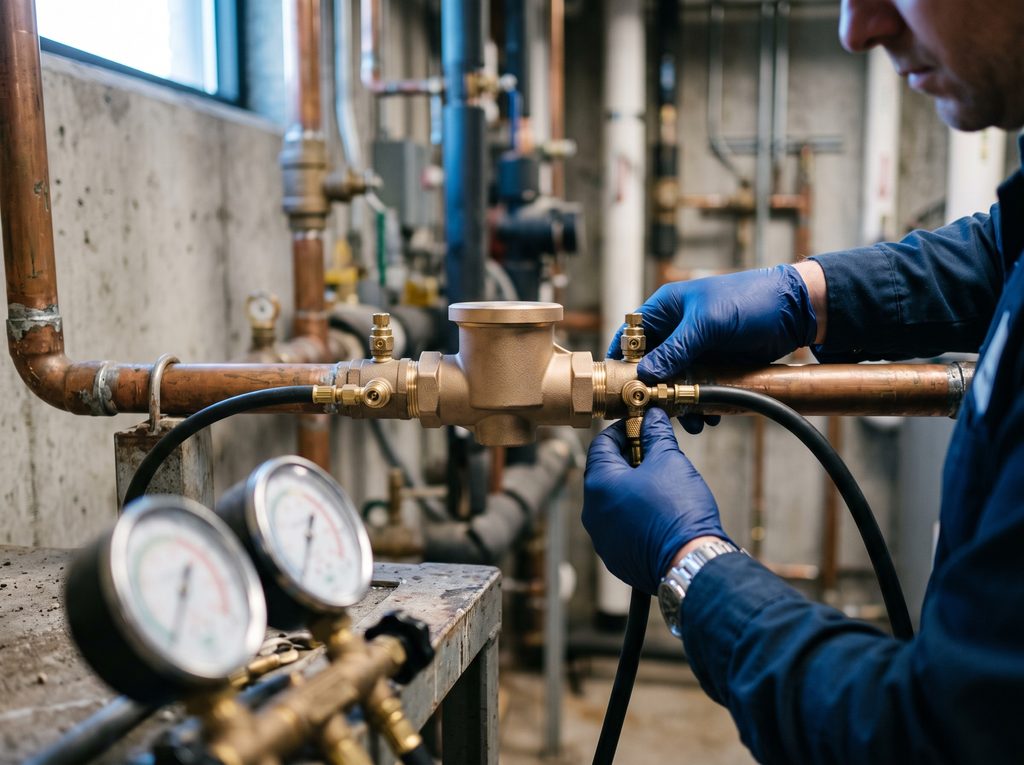
This one is not optional, and it is the item most often overlooked, because the device sits in a mechanical room nobody visits.
What it does is stop contamination of the drinking water. If pressure in the system reverses, water that has been sitting in an irrigation line or a process line can be pulled backward into the potable supply. With landscaping systems, for instance, soil or fertiliser can get into the piping and be back siphoned into the city supply.
So you need backflow prevention devices, and they have to be tested annually.
They are most common on commercial properties, though you will also find them on farms and on residential properties with irrigation.
Our technicians are BCWWA-certified backflow testers. Our backflow testing equipment is dropped off and recalibrated annually to make sure it is accurate. We install these devices, we repair them, and we test them.
Mechanical room equipment
If you have a mechanical room you will have backflow devices needing annual testing, boilers needing servicing, and hot water tanks that should be flushed.
In taller buildings there will be booster pumps as well, because the water has to be driven up the building. There is simply more equipment making the building work, and it all needs regular servicing.
Whether any of it happens comes down to whether the facilities management or the property manager is proactive.
Boilers, where timing matters
In buildings where the boiler runs heating only, it is typically shut down over summer, which makes the pre season service the one to book. Before you start it up you go through it, clean it, and get it ready, so you are not facing downtime or loss of heating once the weather turns.
Some buildings run combined systems where the same boilers serve both heating and domestic hot water, which is a more energy efficient approach. There is no hard rule about which you will have, though more buildings seem to be going combined.
Drain cleaning
An annual drain clean at minimum, then twice yearly or quarterly where usage justifies it.
For restaurant and multi unit kitchen lines specifically, we service one strata complex every six months purely because of oil going down drains, and a hotel quarterly because of one problematic line.
Grease interceptors
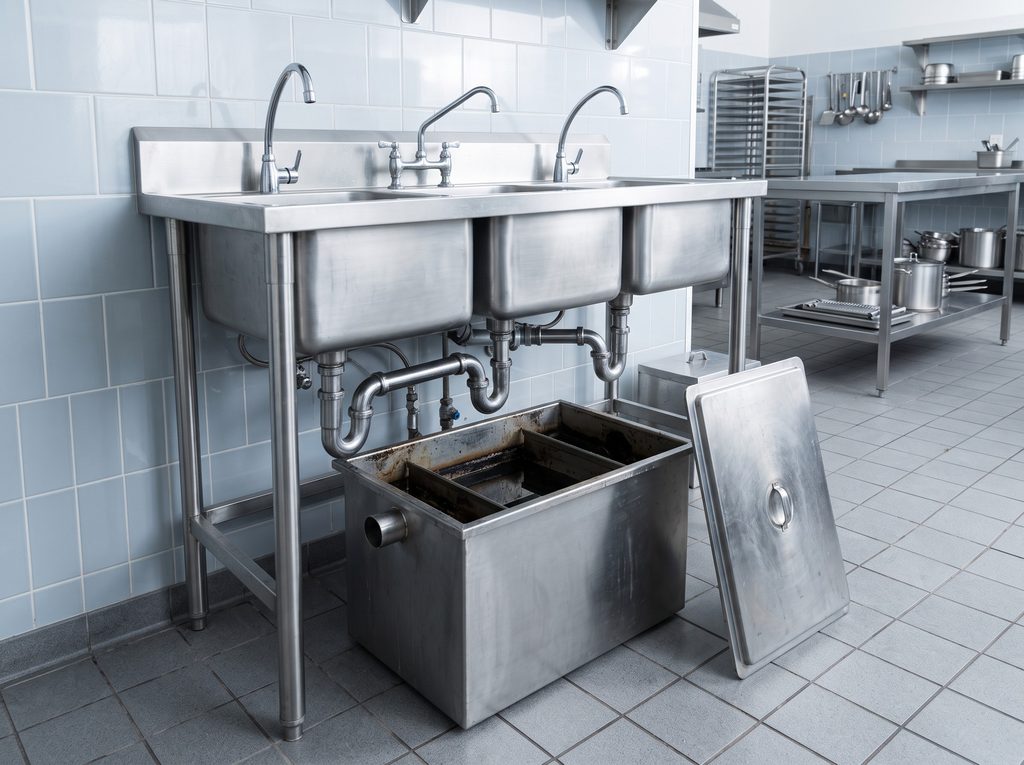
We install and remove grease interceptors, but we don’t clean them. Pumping one out is a job for a separate cleaning company, so book that with them directly. The one maintenance item we will flag is the foam seal on the lid. If we are removing an interceptor, your cleaning contractor needs to empty it and dispose of the contents first.
The things that actually cause commercial callouts
In offices and retail: items being flushed that shouldn’t be. Paper towels and feminine hygiene products, constantly leading to drain clogs.
In restaurants: wear on fixtures, and equipment left running, such as a mop sink left on with a makeshift shut-off rigged up instead of a proper repair.
In strata buildings: oil down the drains, clogging parkade lines, and flooding the lowest units. Add mechanical rooms that go unserviced until the heating fails and every tenant calls at once.
One that isn’t a plumbing problem at all: the person reporting the problem often isn’t the person who saw it. It goes to a manager, or the person above the manager, and by the time we are on site it isn’t what we were told. If you can, get whoever actually saw it to describe it, or send a photo. We can often quote from a photo.
When something breaks: how response actually works
- Triage first. Is it urgent, meaning someone needs to be there in the next four hours? Does it need doing today? Or within the next 48 hours?
- Four hours is the working target for genuine emergencies. We will change the schedule to make it. The facility maintenance companies we work with hold us to that, particularly for blocked washrooms.
- Overnight work is normal and gets quoted. A recent job at Metrotown had to run at night to avoid disrupting the public. Another, for a retailer in a mall, was mandated between 10pm and 6am. A quote goes in for night shift, it goes through the approval process, and then we schedule the crew. We will always tell you up front that it is at overtime rates.
What to do while you wait
- If it is spraying, shut the water off.
- If it is backing up, stop using the fixtures feeding it.
- If it is gas, you can call us, but you can also call FortisBC.
- Don’t put chemicals down it. Partly because it is unlikely to work, and more importantly because of the technician who has to open that pipe. You don’t want them getting that chemical on their skin or in their eyes.
What you get on paper
For clients who need documentation, this often matters more than the work itself.
- Reports before the technician leaves. For one of our clients the service work report goes to their coordinators before the technician has left site. We can do that for anyone who wants it.
- Asset histories. Our software tracks assets such as a hot water tank or a backflow prevention device. We record its details, assign it to a site, give it an asset number, and build up a history with photos over time. For a property manager running annual backflow tests across a portfolio, that history is what makes an audit survivable.
- Before and after photos, and written recommendations on drainage work.
Where this usually lands
Most restaurant owners we have offered preventative maintenance have turned it down. That has been our experience and it probably won’t change quickly.
But the arithmetic is worth doing anyway. An annual backflow test and one drain clean a year are scheduled, quotable, predictable work. A restaurant closed by an inspector on a Friday is not.
Commercial plumbing maintenance FAQ
How often should a commercial building’s plumbing be inspected?
Annually. The inspection covers the drainage, the backflow prevention devices and whether they are being tested on schedule, and the mechanical rooms.
How often do backflow prevention devices need to be tested?
Every year. Our technicians are BCWWA-certified backflow testers, and our testing equipment is recalibrated annually. We install, repair and test backflow devices.
How often should restaurant drains be cleaned?
An annual drain clean at minimum. Kitchen lines carrying a lot of grease should be hydro jetted once or twice a year, depending on volume.
Do you clean grease interceptors?
No. We install and remove grease interceptors, but pumping them out is done by a separate cleaning company.
How fast can you get to a commercial emergency?
Calls are triaged first. For a genuine emergency, the working target is someone on site within four hours, and we will change the schedule to make it.
Can you work after hours?
Yes. Night work is quoted in advance at overtime rates, goes through your approval process, and then we schedule the crew. We have run mall jobs between 10pm and 6am.
Straight Up Mechanical provides commercial plumbing, backflow testing, drain cleaning and mechanical room servicing across Metro Vancouver, including Surrey, Burnaby, Langley, Maple Ridge, Coquitlam, Richmond, Delta, New Westminster, Port Moody and Vancouver.

