
A tankless water heater should last around twenty years. A conventional tank lasts eight to twelve. But that twenty year number comes with a condition attached, and it is the part that doesn’t make it into the sales pitch. It only holds if the unit gets regular maintenance.
So this is what tankless water heater maintenance involves, and what happens if you skip it.
Why scale is the whole problem
Your tankless unit heats water by running it through a heat exchanger, a set of tubes with a burner beneath them. Water goes in cold at one end and comes out hot at the other.
Minerals in the water deposit on the inside of those tubes every time they heat up. If you have ever lived somewhere with hard water you will have seen it in a kettle. Boil water repeatedly and limescale builds up inside, then flakes off.
Same process, except it is happening inside the most expensive component in the unit.
If you don’t service it, the heat exchanger builds up with scale and it will eventually fail well before that twenty year mark.
What we actually do during a service
The whole visit runs about an hour and a half.
Flush the heat exchanger, about 45 minutes of it
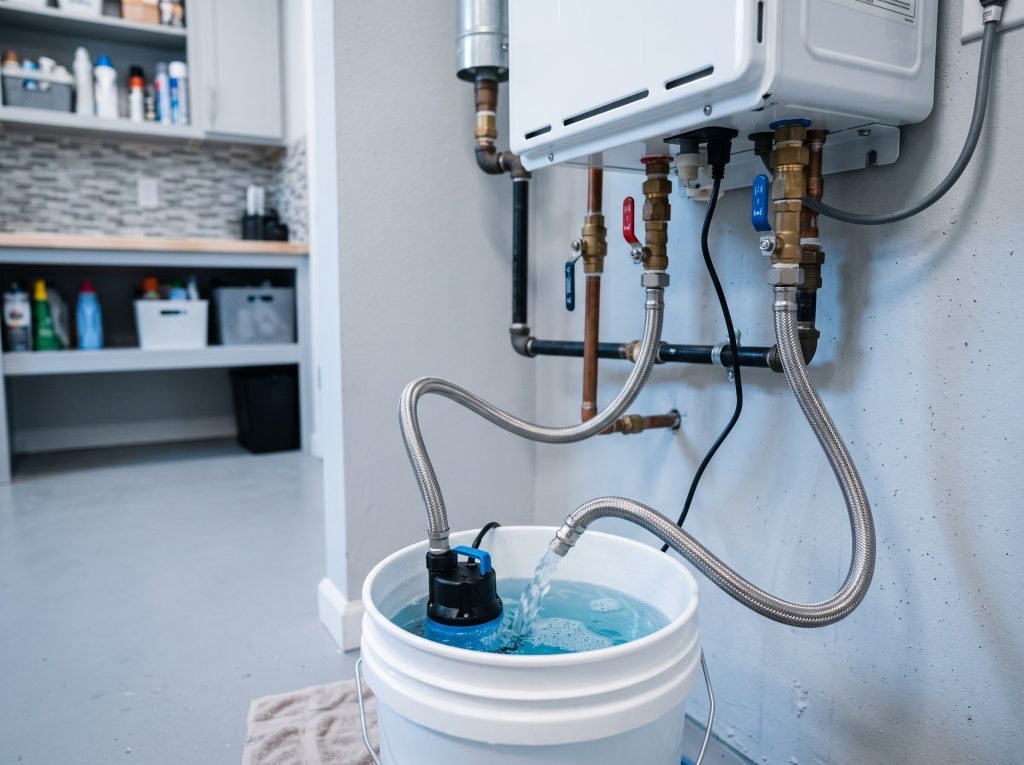
We use a pump and a descaling chemical recommended by the manufacturer (we work mainly with Navien and Rinnai), and circulate it through the unit for roughly 45 minutes. That dissolves the mineral buildup off the inside of the exchanger tubes.
Replace the neutraliser media
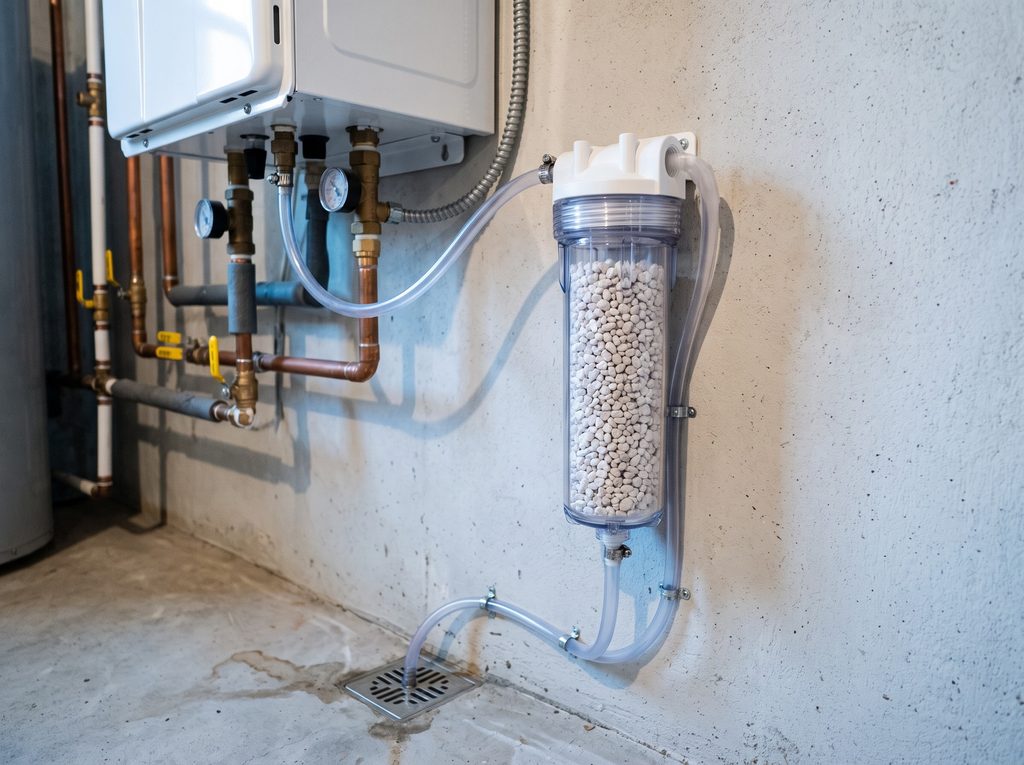
This is the step almost nobody knows about, and it protects your plumbing rather than your water heater. The unit produces condensation that drains away continuously. That water is acidic, and it has to pass through a neutraliser first, otherwise it will eat away at your drains. Inside the neutraliser are beads, and during a service we check them and put new ones in.
Check the air intake
Combustion air is drawn in from outside, through a filter, and outside is full of things that want to get in. Bugs, leaves, birds. It is worth checking, because the intake sits on the exterior of the building.
Read the error log
We check whether any error messages have come up on the unit.
Combustion check, if you want it
We can go further and test that everything is burning properly, and check the gas equipment is operating correctly.
How often should you flush a tankless water heater?
Annually. That is the answer for most homes.
At least one manufacturer allows going to every two years in softer water areas, but our recommendation is to do it yearly. The water in Vancouver is pretty good, and a year is still the sensible interval.
What skipping it actually costs
1. The heat exchanger fails early
Scale buildup means the heat exchanger will eventually fail before the twenty years it should give you.
2. Your drains take acid
Spent neutraliser media means acidic condensate going straight into your drain line, continuously.
3. Your warranty may not be there when you need it
This is the one that catches people out, and it is getting stricter. Manufacturers are increasingly refusing warranty claims on units that haven’t been regularly serviced. They have started coming down harder on it. For reference, Navien covers the heat exchanger for 15 years, parts for 5 and labour for 1.
The pattern we see is that someone doesn’t service the unit for nine or ten years, something fails, and then they are trying to claim a new heat exchanger.
It is like a car. You would get a car serviced regularly to keep it running, and this needs the same thing.
One way to void your warranty entirely
Install it yourself.
We did a job for someone who had installed his own unit and was having problems. Some of it wasn’t installed correctly. The manufacturer wouldn’t deal with him directly and told him to get a plumber, and because he had done the install himself he couldn’t claim the warranty.
What happens when something does fail
The failure economics are different from a tank, and this is the strongest argument for maintaining one.
If your heat exchanger goes, and it shouldn’t if you are maintaining it, you replace that part and the unit keeps going. There might be the odd part to replace over its life, like anything. Whereas when a hot water tank fails, you are replacing the whole tank.
A tankless unit is a serviceable appliance. A tank is a sealed vessel that corrodes from the inside until it leaks, and then it is finished. The sacrificial anode rod inside eventually stops protecting it and the tank starts to go, and people don’t tend to do maintenance on hot water tanks at all.
One caveat worth knowing is that there is generally no early warning on a tankless unit before a failure.
Commercial and multi unit
Servicing scales up. We maintain a hotel in Richmond running eight units. That is the direction a lot of hotels are going, building large banks of tankless heaters rather than storage tanks.
If you have a tankless unit and have never had it serviced
You are not unusual. We service more units than we install, and a lot of them haven’t been touched in years.
Book a tankless water heater service. It takes ninety minutes, it keeps acidic condensate out of your drains, and it protects whatever heat exchanger warranty your unit carries.
Tankless water heater maintenance FAQ
How often does a tankless water heater need maintenance?
Once a year. At least one manufacturer allows every two years in softer water areas, but our recommendation is still annual servicing.
How long does a tankless service take?
About an hour and a half, including roughly 45 minutes of flushing the heat exchanger with a manufacturer-recommended descaler.
Can skipping maintenance affect my warranty?
It can. Manufacturers are increasingly refusing warranty claims on units that haven’t been regularly serviced, particularly heat exchanger claims.
Will a tankless water heater warn me before it fails?
Generally, no. There is usually no early warning, which is one more reason to keep up with annual servicing.
Can I install a tankless water heater myself?
We don’t recommend it. Manufacturers expect a licensed installer, and a self-install can leave you unable to claim the warranty. Every gas install, including replacements, also needs a gas permit through Technical Safety BC.
Does a tankless water heater work during a power outage?
No. The fan, pump and ignition all need power, so there is no hot water during an outage unless the unit is on a generator.
Straight Up Mechanical services tankless water heaters across Metro Vancouver, including Surrey, Burnaby, Langley, Maple Ridge, Coquitlam, Richmond, Delta, New Westminster, Port Moody and Vancouver. We work directly with Navien and Rinnai, with manufacturer training and direct manufacturer support.

