
Frozen pipe repair means thawing a water line that has iced up, checking whether it split, and fixing it before it soaks a wall, ceiling or crawlspace. In the Lower Mainland, it almost always happens during a short, sharp cold snap, in homes that were built for rain far more than for freezing temperatures.
I’m Nick Perry, and I run Straight Up Mechanical, a plumbing company serving homes and businesses across the Lower Mainland. We don’t see frozen pipes every winter. In a real cold snap we might get two or three calls, and other plumbers get their share too. The ones I remember all have the same thing in common: a few minutes of prep in the fall would have prevented them.
This guide is for homeowners, townhouse owners and strata residents here. It covers where pipes actually freeze in local homes, what to do in the first ten minutes after a pipe bursts, how we thaw and repair frozen lines, and what frozen pipe repair costs.
In this guide:
- Why pipes freeze in Lower Mainland homes
- Where pipes freeze: the spots I see most
- A real job: the soaker tub that froze 12 feet from the draft
- What to do if a pipe bursts
- What to do when you can’t shut the water off
- How we thaw a frozen pipe
- Frozen pipe repair cost
- Does pipe material matter?
- Three things to do before the first frost
- Frozen pipe FAQ
Why pipes freeze in Lower Mainland homes
Most of our winters are mild and wet, so a lot of local homes never got the protection you’d expect somewhere colder: heat trace on exposed lines, insulated pipe in garages, tightly sealed soffits and attics. When the temperature sits below zero for a few days, the weak spots show up fast.
In my experience, frozen pipes come down to two things. The pipe doesn’t have enough insulation, or it runs through a space that isn’t heated. Add a draft and a line can freeze even when the rest of the house feels warm. I see it most in older buildings, often from the 80s and 90s, where wind finds its way into places it was never meant to reach.
Where pipes freeze: the spots I see most
Hose bibs (outdoor faucets). This is the most common cause by far. Here’s what usually happens: you shut the hose bib off for the season but leave the hose attached, still full of water, with the sprayer closed. That hose stays at full pressure. When the water freezes it expands, and all that pressure pushes back into the hose bib.
People with a frost-free (anti-frost) hose bib often assume they’re covered. A frost-free bib has a rod, usually 6 to 12 inches long, with an O-ring that seals inside the warm part of the wall. Leave a full hose on it and the trapped pressure can still damage it. You might not see a leak right away. You find out in spring when you go to water the garden and the bib won’t turn on, or it starts leaking. Fixing it usually means getting into a crawlspace or opening up a finished wall inside, and often replacing the whole unit.
Garage lines on exterior walls. One townhouse call was a hose bib line running through the garage along an exterior wall. It had no insulation and no heat trace. It froze and split. Luckily it had its own shutoff valve, so the owner could stop the water to that line without shutting off the whole house.
Rooms you don’t heat. Plenty of people close the vents or turn the heat off in a spare bathroom or a room they rarely use. If that room has plumbing near an exterior wall or a draft, it’s at risk.
Exterior walls. Good practice keeps water lines out of exterior walls for exactly this reason, but it doesn’t always happen. I’ve had a vanity faucet stop working because its plumbing ran in an exterior wall. Ceiling spaces are usually insulated, and interior walls are warm enough that pipes there aren’t insulated at all, so exterior walls and drafty voids are where I look first.
Parkades and commercial buildings. In commercial buildings you’ll often see heat trace on piping in a parkade, because wind blowing through can freeze those lines. Heat trace is an electrical cable wrapped along the pipe and covered with insulation. It works a bit like an electric blanket, keeping the pipe just warm enough not to freeze.
A real job: the soaker tub that froze 12 feet from the draft
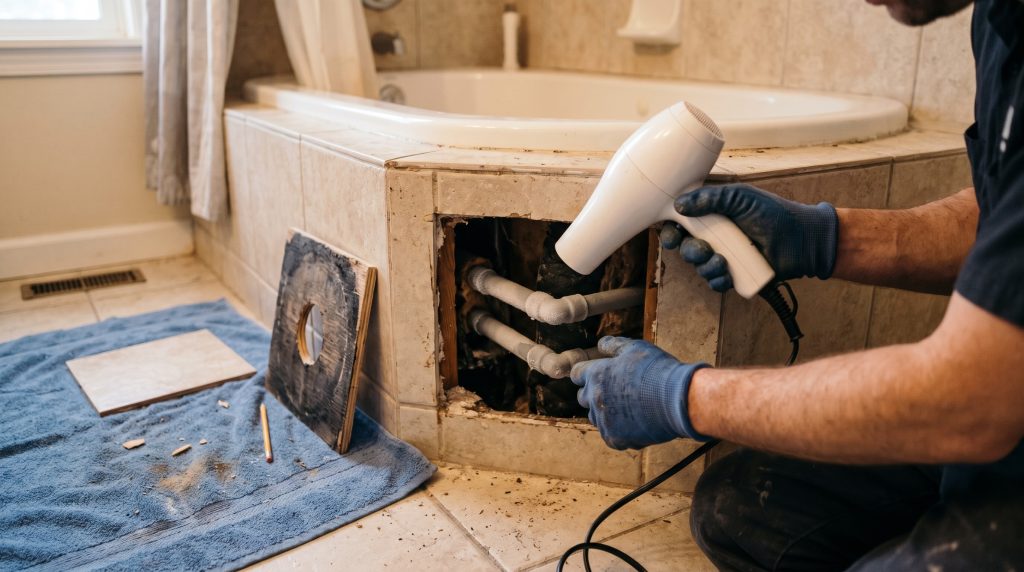
The strangest frozen pipe job I’ve done was in a detached house. The Roman faucet on a second-floor soaker tub had stopped working. A Roman faucet sits on the side of the tub, so the two supply lines come straight up from underneath to the deck. The tub itself sat about three feet off the exterior wall, nowhere near the outside.
It took some mapping to work out how those lines could have frozen. The answer was the roof. Wind was blowing up into the soffit and travelling under the arch of the roof, a good 12 feet, until it reached the void around the tub. When I removed a tile and cut through the plywood on the side of the tub, I could feel the cold draft coming in. The room probably wasn’t being heated either.
The lines were poly-B, and they had frozen solid. I opened the valve, put a hair dryer on the pipes and warmed them slowly until water started trickling, then flowing. There were two areas to deal with, and once they were running again I insulated the pipes so it wouldn’t happen again. All in, about four hours, mostly spent getting access. I’d never seen one like it before, and it’s a good reminder that a pipe doesn’t need to be on an outside wall to freeze. It just needs cold air to reach it.
What to do if a pipe bursts
When someone calls us with a burst pipe, the first thing I tell them is the same every time:
- Shut off the water. Use the main shutoff for the house, or the separate isolation valve for that line if there is one. The goal is to stop any more water getting out and limit the damage.
- Call a plumber. Once the water is off, the damage stops growing. If you’re in the Lower Mainland, our emergency plumbing team can help.
- If a pipe is frozen but hasn’t split, leave the tap on that line open. When the ice starts to melt, flowing water helps clear the rest.
The single most useful thing you can do before winter is find your main shutoff, so you’re not hunting for it while water is spraying.
What to do when you can’t shut the water off
Sometimes shutting off the main doesn’t help, because the leak is on the supply line before the shutoff valve. I was called to a townhouse where water was spraying out of the sleeve where the pipe comes up through the ground, just below the unit’s shutoff. Turning the valve did nothing.
Nobody could find the shutoff for the complex. The city came out and throttled the water but couldn’t shut the whole complex down. The strata sent their own plumber, and even with a locating tool he couldn’t find it. It was a mess for everyone involved.
What you should do depends on your property:
- Detached house: call the city to shut off the outside valve. It takes a special key, and if anyone (including a plumber) damages it, the city charges them for the repair, so leave it to them.
- Townhouse or strata: contact your strata right away. If you can’t shut your water off, it’s best for the strata’s plumbing company to come out and deal with it.
How we thaw a frozen pipe
If a pipe is frozen but hasn’t split, we thaw it slowly with a hair dryer. Open the tap or valve on that line, warm the pipe gradually, and the ice melts until water flows again. Slow and steady is the point.
The hard part is finding the frozen section. With plastic pipe like PEX, you can sometimes feel it by gently flexing the pipe, though you have to be careful. More often you need access, which means opening a wall, ceiling or tile to look. We rule out the likely-warm spots first (insulated ceiling space, interior walls) and focus on exterior walls, drafty voids and unheated rooms.
Once water is running, we check the pipe for splits and insulate it before closing things up. If it did split, it gets repaired before the water goes back on.
Frozen pipe repair cost
We do frozen and burst pipe repairs as time and material, because there are too many variables to price it any other way. It all comes down to access. A crawlspace with low clearance can turn a simple fix into a slow one, and you never know what’s behind a wall until it’s open. I’ve opened walls and found a fitting jammed tight against a stud, with no room to work.
Our residential rates are:
- Travel fee: $89
- Labour: $160 per hour
- Shop supplies: $25 (gloves, tape, washers and the like)
- Materials: as needed
Some repairs take as little as an hour. Most residential frozen pipe jobs are done within about four. Here’s how that works out (illustrative examples, before materials and tax):
- Simple, easy-access repair (1 hour): $89 + $160 + $25 = $274
- Harder access, like the soaker tub job (4 hours): $89 + (4 × $160) + $25 = $754
Finding the problem can take time too. Diagnosis is usually within an hour, though I’ve had the odd one take a couple of hours. Larger commercial jobs are a different scale: one building shutdown in Richmond had us on site for about eight hours. If a job looks like it will go past what we’ve discussed, we stop and check in with you first.
Does pipe material matter?
Homeowners often ask whether poly-B, copper or PEX holds up worst in a freeze. Honestly, in my experience, location matters more than material. The soaker tub lines were poly-B, but any pipe in an uninsulated, drafty or unheated spot can freeze. Insulation and keeping cold air away from the pipe do far more than the type of pipe.
Three things to do before the first frost
If you do nothing else this fall, do these:
- Disconnect your garden hose. Take it off the hose bib completely. This one step prevents most of the frozen hose bib calls I see.
- Shut off and drain the hose bib. If your outdoor faucet has a shutoff valve inside the house, close it, then open the outside bib so the water drains out, and leave it open all winter. As a backup, put a Styrofoam cover on it; they cost about $5 or $6 at Home Depot. If your hose bib has no shutoff, the cover is a must.
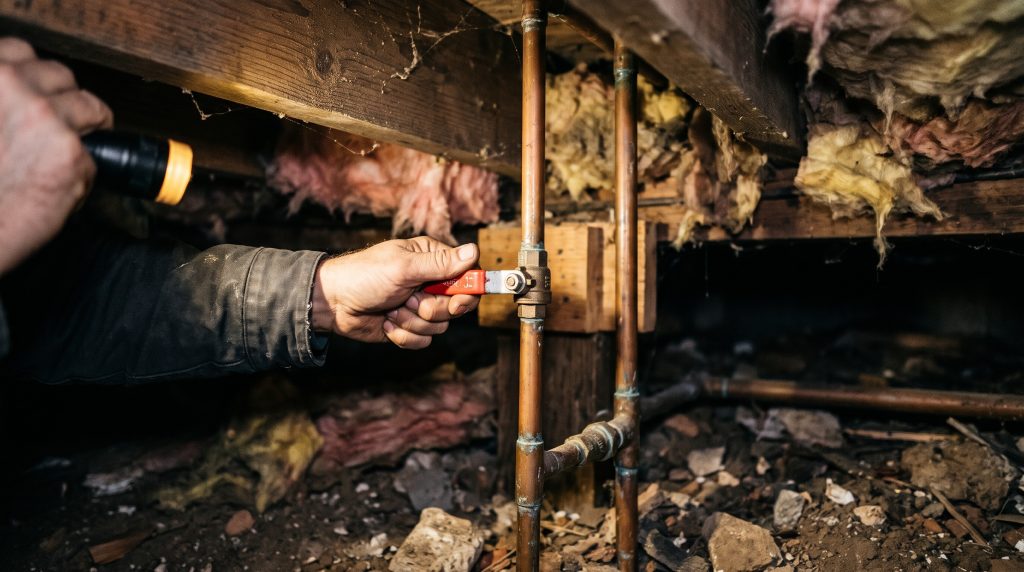
- Find your main water shutoff, and test it. A lot of people I ask don’t know where theirs is. Knowing where it is isn’t enough either. Valves that sit untouched in a crawlspace for 20 years can seize, so turn it once now to make sure it actually works.
And if you have rooms you don’t normally heat, keep a little heat on in them during a cold snap.
Frozen pipe FAQ
How do I know if my pipes are frozen?
During a cold snap, a tap that won’t run, or only trickles, is the usual sign, especially if it’s on an exterior wall, in a garage or in a room you don’t heat.
Can I thaw a frozen pipe myself?
If you can reach the pipe and it hasn’t split, open the tap and warm the pipe slowly with a hair dryer. If you can’t get to it, or you see water leaking, shut off your water and call a plumber.
How much does frozen pipe repair cost in the Lower Mainland?
With us it’s time and material: an $89 travel fee, $160 an hour and $25 shop supplies, plus materials. A simple one-hour repair starts around $274 before materials and tax.
Will a frost-free hose bib protect me?
Only if you take the hose off. A full, pressurized hose left on a frost-free bib can still damage it, and you may not find out until spring.
I live in a strata. Who do I call?
Shut off your unit’s water if you can. If you can’t, or the leak is before your shutoff, contact your strata right away so their plumbing company can respond.
How long does a frozen pipe repair take?
Most residential repairs take between one and four hours, depending on how hard the pipe is to reach.
If a pipe has frozen or burst in your home, shut the water off and call our emergency plumbing team. And if it hasn’t happened yet, take ten minutes this weekend to disconnect your hose and find your shutoff.

